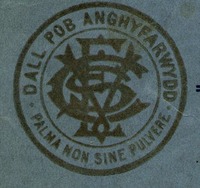
Currently we have three articles relating to the school's history.
History
of the school - a comprehensive history of the school
from its beginnings in 1897
The 40s, 50s and 60s - some notes on the
school from the mid 20th century
My Life in Ebbw Vale - Nadine
Baldock (nee Weller) recalls her childhood in Ebbw Vale
History of the School
We aim only to give a brief outline of the school from its small beginnings to what became the largest school in Monmouthshire. Simultaneously, we hope to arouse pleasant memories for the generations who survive by taking a light hearted and sometimes irreverent look at the personalities and events which filled these decades. In the magazine of 1947 the hope was expressed that at the school's centenary "the magazine will still be going strong". Judge for yourselves!
Secondary
school education arrived in Ebbw Vale in September 1897 as a
direct result of the Intermediate and Technical Education Act of
1889. Only six other "County Schools" were founded in
Monmouthshire around this time as the initiative for founding a
school lay with the locality where the school was desired. There
was certainly much enthusiasm in the area and in April 1890 John
Edward of the Ebbw Vale Local Board sent a letter to the
Monmouthshire Joint Education Committee informing them that his
Board had unanimously passed a resolution in favour of such a
school for intermediate education at Ebbw Vale.
In October 1894 it was agreed and the school was to be erected at
a cost of not less than £2000 with accommodation for 60 boys and
40 girls. The County Governing Body contributed £1500 and the
remainder was achieved by public collections and a voluntary 6d a
week contribution from the miners' and steelworkers' wages.
A site problem was solved when the Marquess of Worcester provided
three acres of land between Ebbw Vale and Beaufort and architects
were appointed in February 1897. It was decided that provision
would be made for four classrooms, a Music and Art Room, kitchen,
laundry, scullery, Science Laboratory and a Workshop. In addition
there would be cloakrooms, staffrooms and the boys and girls would
have separate entrances even though they attended the same
classes. We all can still remember and recognise the building of
"Ebbw Vale buff brick with bands of red and dressing of Bath
stone". The school was formally opened by Sir William
Harcourt MP on the 20th. September 1899 but the pupils were taught
in the building for some months previously.
The school itself was inaugurated on 20th. September 1897 and
while the new school was being constructed the girls were taught
at Libanus Welsh Congregational Church and the boys at James
Street Methodist Chapel schoolroom - the accommodation provided
free of any charge. The headmaster was Mr J R Morgan BSc., the
assistant master, Mr F G H Cooper and the two assistant mistresses
were Miss E M Short BA and Miss F E Davies.
Application for admission of pupils had to be made in writing and
the scheme provided that no applicant should be admitted without
either:-
a) passing an
examination equivalent to the '4th. standard'.
or
b) if a scholar in a public elementary school had reached that
standard in school.
The fees were 15/- per term for the first child from a family and
for subsequent children the fees were reduced to 10/- per term. A
charge of 1/6d was also made for stationery and pupils had to
provide their own text books. These charges were at a time when
the average miner's wage ranged from 23/- in 1892/94, 21/- 1895/97
and 33/- in 1898/1900. However a limited number of scholarships
were available for more able pupils.
The number of pupils on the register a month after the opening was
37 boys and 50 girls. The school colours were blue and gold and
the main subjects taught were those of the traditional
"public schools" viz.. Latin, French, Mathematics and
the sciences. Pupils worked for Central Welsh Board Certificates
and also the examination of the Science and Art Department. In
January 1900, four County Exhibitions were awarded - two @ £30
and two @ £20 each with free instruction at University College,
Cardiff. One was awarded to Richard Emrys Thomas and so he became
the first pupil of Ebbw Vale County School to embark upon a
university education.
Mr. Morgan, the
first headmaster remained in post until 1930. He was a sincere and
kindly man, devoted to his task of building up good and worthy
citizens and under his care and guidance the school achieved
considerable success.
His successor, Mr. D T Davies, MA. BSc., inherited the school of
375 pupils which now had nine classrooms, all of which were too
small to accommodate the classes of 35 pupils even with the
addition of three annexes. This situation was aggravated in
January 1931 when fire broke out and caused much damage. As a
result of the fire 1st. year and some 2nd. year pupils had to be
accommodated at the Princess and Workmen's Halls until July of
that year. In fact, the Princess Hall, close to the Workmen's
Hall, was retained until 1934 when the "New Block" was
added. These new buildings were further extended in 1938 to
include an Art Room, Biology Laboratory, Woodwork Room and Science
Demonstration Room. These were opened the month that the Second
World War started but in the Jubilee Year of 1947 three annexes
were still in use - the 'sacred Tin-tab', the Libanus Annexe and
the Glanyrafon Hut. A 'wireless set' was installed in the early
'30s and such events as the 1937 Coronation Ceremony as well as
lessons in Welsh, French, German, History and Civics were
broadcast.
The first Monday in June 1940 saw the evacuation of staff and
pupils from Dover Grammar School to Ebbw Vale where they would
stay until December 1944. At first there was a shift system - one
week the Dover school would work mornings and Ebbw Vale afternoons
and vice versa the following week with Saturdays included. The
morning shift started at 8.00a.m.. and the afternoon shift
finished at 5.45p.m. When the Junior Instruction Centre at Pentwyn
House closed in 1942 some of the Dover pupils were taught there
and the shift system abandoned. An excellent relationship existed
between the schools and the Silver Trophy Cup at Dover and the
Annual Prize Books at Ebbw Vale served to perpetuate the story.
The curriculum was expanded under Mr. Davies, to include at School
Certificate level, Commercial Subjects, German, General Science,
Biology, Music, Practical Geometry and Needlework. Welsh was
introduced as one of the subjects of the general course taken by
all pupils at entrance and as an optional subject at School
Certificate. At "Higher" level, on the Arts side, he
added Latin, German and Music to the existing English, History,
French and Geography. On the Science side, he added Biology,
Botany and Zoology to Maths, Physics Chemistry and Geography.
Before the Second World War, school excursions and annual visits
to other European countries were always popular. Later we shall
read of the mass exodus to Aberystwyth to celebrate the Jubilee in
1947.
It was in 1931 that the school was divided into four 'houses',
Dyfed, Gwent, Gwynedd and Powys. Many will remember the
inter-house rivalry at the annual Eisteddfod and sports day.
The school magazine was originally called "The Ebbw Valian"
- the last edition of which appeared in 1939. There was no
magazine in 1940 or 1941. The 1942 issue- the first 'Blue and
Gold' explains this by stating,- "The Battle of Britain had
not yet roused us from our despondency and in those days school
magazines seemed of little importance"
The mid-day school meal or the "school dinner" as most
of us remember it was introduced in 1941. Prior to that pupils
brought their own food which supplemented the one third of a pint
milk break. Dinners were taken in two sittings, both of which were
over-crowded and often there was an overflow from the Library into
the Domestic Science Room. Can any of us forget the evocative fug
produced by swede and potato served with boiled cabbage?
In 1945 "Victory Parties" were held in relays for
Junior, Middle and Senior Schools between 3.00p.m. and 11.30p.m.
on 5th. of June. During the parties each pupil was given a copy of
the King's letter to schools.
By 1946 the
school was the largest in the county outside Newport with 576
pupils. For the first time there were three forms throughout and
the first husband and wife team, Mr and Mrs Dewi Samuel, on the
staff.
For many years a Past Students' Association thrived which
organised social activities, and provided a silver cup as an
inter-house trophy and a book prize in memory of Mr. J.R.Morgan,
the first headmaster. After the 1914/18 war the Association
co-operated with the school in the erection of a plaque, a
memorial to those who 'fell' in the war, and between the wars they
sent a wreath of poppies every year on Armistice Day to keep fresh
the memory of their fallen schoolmates. After the second World War
the association again co-operated with the school in providing a
worthy memorial to those students who had lost their lives in this
war. In the Jubilee Brochure of 1947 the retiring head, Mr. D.T.
Davies cited idealistically in the early glow of peace and
international friendship:-
"These
things shall be, a loftier race
Than e'er the world hath known, shall rise."
Have we, the survivors and descendants of that generation, really
lived up to his hopes?
At the same time, Mr J C Booth, headmaster of Dover County Grammar
School for Boys, uttered his wish "Floreat Schola Eburicae
Vallis!" - Long Live Ebbw Vale County Grammar School and
being further translated "O bydded i'r hen ysgol barhau".
Later in 1947 when Mr Davies retired, his post was filled by Dr C
R T Saffell who very much achieved his stated aims "to make
this school something which we can enjoy and something of which we
can be proud." His concepts of "using your brains, doing
anything which you undertake to the best of your ability and to
think of others" certainly pervaded his years as headmaster
from 1947 to 1955.
More light-heartedly, pupils of this vintage will remember Mrs
Olwen Samuel's association with the popular song of "Can't
help loving that man of mine" and even in these years,
Shakespeare's comment, "Tomorrow and tomorrow and
tomorrow" still held good on the proposed new playing fields.
It is worth noting that the only flat parts of Ebbw Vale then
where one could have any kind of football or cricket game was the
Bridgend Field, now the Eugene Cross Park, completely 'out of
bounds' , French's Field, more a 'paddy' field and the West End
field where you risked being 'caught' by very stern adults! The
streets took on the mantle of the Bridgend Field and 'up the tips'
it was amazing, looking back, how much space there was on a flat
area 20 yards square between mounds of shale sufficient to play
"3 goals in!"
In 1949, the senior mistress, Miss Hannah Williams BA., left and
was succeeded by Miss Iris V Davies BSc., an "old girl",
who remained in that post until retirement. "Detention"
was at least temporarily abolished and so no longer did Room 2
figure negatively in the nightmares of future renegades.
The year 1949/50 marked the end of Central Welsh Board and the
arrival of Welsh Joint Education Committee examinations which
seemed of little significance in comparison with the introduction
of the School Tuck Shop with its luxurious cream-filled 2d buns
and the face-lift of the "Tin Tab". "Bronwydd"
now looked complete except for furniture. This sixth form annexe
certainly gave delight to subsequent generations of "A"
level students who added a tidy game of table tennis to their
other pursuits. Mr. Josh Jones retired in 1951 after 43 years
service to the school-- a real "man and boy" commitment.
Many will remember his individual approach to education rather
cruelly and inadequately summed up by "If my hat's there,
boy, so am I!" In 1954 he returned to school as an
"occasional teacher".
The year
1952/53, like almost every other school year, was punctuated by
the traditional school concert, Eisteddfod, Annual Prizegiving,
the Parent Teacher Association Garden Party and the end-of-term
dances and parties. Mr Ewart Williams, a much respected senior
master and "old boy" of the school, retired at the end
of the year and all these events obviously took precedence over a
very damp Coronation in June and the General Inspection in
November by Monmouthshire County Council when "single
spies" did their scouting over three weeks and "whole
battalions" ravaged the school for three days.
There were many eminent guest speakers at Annual Prize Givings but
1953/54 saw a special one when Wilf Wooller, the famous Welsh
sportsman, received a rousing welcome and it was felt that a
little more attention was paid to his words of "Wisdom/Wisden"
than was usually the case.
For the first time we hear of a temporary ban by teachers on
out-of-school activities. Was this the beginning of "Modern
Times"?
In the Spring of 1955 Dr Saffell departed and with his leaving a
significant era ended. He had brought with him in 1947 the glamour
of reputed war service with the "Maquis", the French
Resistance Movement, and his constant determination to know his
students and to get the best from them. Many would wish to thank
him for his humanity, his insight and his support of school
societies which flourished during this period and perhaps most of
all for the "peep over the parapet" so necessary for
small communities. In these days of "Mission Statements"
one would do well to read his in the "Blue and Gold" of 1948
which reflects his ethos of education as 'not merely a matter of
instruction'. His enthusiasm was really contagious.
"Vale" Dr Saffell and "Ave" Mr R C Smith BA.
BSc. who, having been born and bred in a North Wales industrial
town, was able to identify himself with the needs and aspirations
of the people of Ebbw Vale. His arrival coincided with the
apparent gifts, at long last, of a new playing field and dining
hall.
Another milestone was the joint retirement of Miss Lindberg and
Miss Hughes in 1958. The latter had worked at the school for 41
years and in the "Blue & Gold " of that year it was
stated "they have separately and together brought to the
school over the years a distinction which we hope it will never
lose." 1961 saw the retirement of Mr Harrison, who having
been appointed in 1928 to teach Commercial Studies, became more
associated with the teaching of Music.
It was about this time that a new school crest and uniform were
adopted.
In 1962 an important stage in the musical life of the school
occurred with the production of "The Mikado" in the
Beaufort Theatre. It was noteworthy for two reasons; first that
nothing of this kind had taken place for fifty four years and
secondly a boys' chorus was enrolled to sing with the already
established girls' chorus. Other successful musicals followed in
subsequent years.
Late in 1962 the new Assembly Hall replaced the 'Tin Tab' and the
Laboratory block came into use. For the first time in its history
the school could enjoy the spaciousness, the light and the dignity
of the new hall for morning assembly and for the school public
functions. The new laboratories soon proved how valuable separate
laboratories were for the Upper School and how useful it was for
the rest of the school to have the full number of laboratory
periods.
The Parent
Teacher Association continued to organise various activities of a
social nature and every opportunity was taken to raise money to
provide extras which the education authorities did not provide. £600
was contributed towards the cost of an organ for the magnificent
Assembly Hall. Later amounts provided a platform table, chairs,
carpeting and a water set for the table. This hall meant that no
longer did the school have to hire other premises for the larger
functions and the carol service at Carmel Chapel, Beaufort in 1961
and the 1962 Eisteddfod held in the Workmen's Hall, were the last
to be held outside the school. Thus, in 1962, with the new
Assembly Hall and the Laboratory block coming into use, there was
the "New Block" and the "New, New Block" The
buildings which opened in the 1930s continued to be known as the
"New Block!"
Later in the decade the hall proved invaluable for the staging of
a series of prestigious concerts, including the Welsh National
Opera Company, which were sponsored by the Parent Teacher
Association with financial support from the Arts Council.
The year 1964/65 saw the Technical School,- staff and pupils,
being absorbed into the school, swelling the roll number to over
600. The curriculum was further enlarged with the introduction of
Economics and British Constitution. Although the school never
became a Grammar Technical School, the magazine was known by that
title for two years. Culturally the school had an active year with
visits to ballet, opera and other stage productions and a visit to
the school by a youth orchestra from Los Angeles. There was also a
visiting group from the Theatre Centre which gave the entire
school a demonstration of the Shakespearean Theatre. The school
production of "As You Like It." was produced in a most
ambitious and imaginative way with an 'on stage behind the set'
orchestra and it was very well received.
The school also took part in the Television Quiz "Top of the
Form" and the team of girls acquitted themselves very well.
On the morning of the competition, Paddy Feeny, the question
master, was heard muttering "Dall Pob Anghyfarwydd" to
himself like a parrot to prepare for the introduction for the
broadcast!
In the 1964/65 magazine there was a sad announcement:- "There
will be no report from the Past Students this year as the
organisation no longer exists but £600 has been raised to provide
premises." This money was subsequently given to the Senior
Comprehensive School.
In 1967 Mr. Frank Evans retired. He had been appointed as Senior
English teacher in 1927 and had been promoted to the post of
Deputy Headmaster in 1955. In all that time he gave loyal service
and his teaching was distinguished by his unstinting thoroughness
and meticulous care. Many will remember his distinctive high
handle--bar steed in earlier years called Emma . His conversion to
a Ford Cortina illustrated the changes inside and outside the
school in that forty year period.
Sadly, this year saw the death of Mr. Wynne Roberts. He was a
great scholar, a dedicated teacher a sportsman and a musician. The
"Gazette" of August 1973 published a tribute to him from
Gwyn Thomas, author and broadcaster, who was a friend of Wynne's
at Oxford;- "I would have wished a knowledge of Wynne on all
mankind for through himself he conveyed the whole experience of
those peculiar, lovely people who by their words or attitudes
would have caused some flower to bloom in our wilderness, some new
hint of resurgence in our long drowned shame. He set so many
thoughts alight that the Philistines complained against the
lessening of their favourite child -- the dark!" Mrs.
A.M.Roberts became Head of English in her late husband's place and
brought her own distinctive and considerable scholarship to the
department.
1971 was the year of the fire. It was started in the old part of
the building, caused much damage and destroyed valuable records.
From that time the male staff were accommodated in one of the
ground floor rooms in Bronwydd. In that same year Mr. Gordon
Hopkins, who had succeeded Mr. Evans as Deputy Headmaster and
Miss. Iris Davies, Senior Mistress, both retired.
'Hoppy' gave
forty years of steadfast and loyal service and as Senior Chemistry
Master displayed an extraordinary talent and, like many other
teachers, he will never be forgotten by those who were lucky
enough to be taught by him.
Miss. Davies gave twenty five years outstanding service and for
twenty three of them she was Senior Mistress. Her efforts on
behalf of the girls were untiring and she displayed a remarkable
insight into their problems and proffered unfailing advice and
comfort.
Mr. Samuel succeeded Mr. Hopkins as Deputy Head and Mrs. Samuel
succeeded Miss Davies as Senior Mistress and their contributions
to the academic and cultural life of the school, town and country
were significant. Over many years the school derived great benefit
from the long and dedicated service of so many members of staff.
The roll of honour is long and we mention but a few as follows:-
Idwal Davies, Gwylfa Davies, Tom Davies, Barbara Evans, Marsden
Evans, Morfydd Griffiths, Llew Harrhy, Millwyn Jenkins, Muriel and
Trevor Rees and Emrys Plummer. Others who also gave decades of
service to the school have already been mentioned.
In 1972 Mr. R.C.Smith retired. The school had always been close to
his heart and he set high standards of behaviour and achievement.
He unreservedly supported both staff and pupils in their ever
widening activities and gave every encouragement to the Parent
Teacher Association, knowing how important was their backing.
Mr. Smith could be described as the last of the "old
style" Heads; not for him the luxury of having the
assistance of a team of specially appointed Deputies. His dour
countenance was a facade for he was a sensitive and caring man.
Mr. Mostyn Phillips, an 'old boy', became headmaster and he guided
the school with great skill and energy through the trauma of
reorganisation. In December 1975 the Grammar School moved from
Beaufort Road to the new Senior Comprehensive School at Waunypound
Triangle. In September 1976 the Comprehensive system started but
the merger was not completed until 1978. The Junior Comprehensive
Schools at the old Grammar School site and at Glyncoed covered the
first three years of secondary education and the students then
transferred to the Senior School for fourth year tuition onwards.
The contribution of the school governors should not be forgotten.
Throughout the years practical support and great encouragement
were given to the school by its governors and their objective was
that the new generation should have a better educational
opportunity than the previous one and for that our thanks are due
to them all.
Sadly, in the last few months Mrs. Roberts, Mr. Hopkins and Mr.
Griffiths have died and will be remembered with affection by all
those who knew them.
During the past one hundred years there have been sporting and
academic successes too numerous to detail and in this magazine an
attempt has been made to give a balanced and highlighted history
but it is accepted that much more might have been included. This
is regrettable but almost inevitable and one is tempted to suggest
that a more detailed history could well be produced by an
interested party to do more justice to a wonderful school.
Some
highlights of the 40s, 50s & 60s
1947 was the 50th anniversary of the school and it was recognised
by "taking" the school to Aberystwyth to the National
Library of Wales. To those of us at that time, whose only
opportunity of leaving Ebbw Vale was the annual Sunday School
outing to Barry Island on the G. W. Railway, this was an
expedition to one of the most outermost parts of the world ( some
people might think it still is!). Who could ever forget the huge
convoy of 20? buses, not coaches, snaking its way on the
relatively unused roads? On the curved parts of the roads if you
looked in front there were buses as far as the eye could see and
then if you turned around a similar view could be seen! I cannot
remember very much about Aberystwyth but I can remember the buses!
Later that year, the head Dr. D. T. Davies retired and he was
replaced by Dr. C. R. T. Saffell who very much achieved his stated
aims "to make this school something which we can enjoy and
something of which we can be proud." His concepts of
"using your brains, doing anything which you undertake to the
best of your ability and to think of others" certainly
persuaded the those in years 1947 to 1955.
1948/1949 brought staff changes , the most significant, perhaps
was the retirement of Miss. Williams, the senior mistress whose
position was filled by Miss. Iris V. Davies who remained in that
post until she retired in 19--
Another milestone was the abolition of "detention" so no
longer did Room 2 figure negatively in the nightmares of future
renegades.
1949/50 The end of C. W. B. and the emergence of W. J. E. C.
seemed of little significance in comparison with the introduction
of the School Tuck Shop with its luxurious cream-filled 2d buns
and the face-lift of the "Tin Tab".
1950/51 Mr. Hugh Griffiths bravely escorted a trip to Innsbruck
where perhaps a little different from the 90s, the only untoward
incident was Peter Marchant being kicked about the shins by a
French lady. I wonder if Pam has heard the story!
1951/52 was merely the 55th. anniversary of the school's
foundation and like many 55 year olds was enjoying the prime of
its life. "Bronwydd" now looked complete except for
furniture. This sixth form annexe certainly gave delight to
subsequent generations of "A" level students who added a
tidy game of table tennis to their indications of mis-spent youth.
Cupid's dart scored a double that year when Miss Barbara James
married Mr. Alan Evans and Miss Morfydd Williams became engaged to
Mr. Hugh Griffiths. Contemporaries will remember that these were
the halcyon days of school parties and Prefects' Dances with the
egalitarian spirit uppermost as prizes were won by Eric Smith as
Confucius and Miss Iris Davies as the Duchess of Dillwater.
1952/53. The Eisteddfod, the school concert and the Parent Teacher
Association Garden Party marked the progress of the school year at
the end of which Mr. Ewart Williams, senior master, retired. All
these events obviously took preference over a very damp Coronation
in June and the General Inspection in November when "single
spies" did their scouting over three weeks and "whole
battalions" ravaged the school for 3 days.
1954/55. Dr.
Saffell's departure saw the end of a wonderful era for the school.
"Vale" Dr. Saffell and "Ave" Mr. Smith who
took up his duties in the year which saw the opening of the
school's new playing fields and the dining hall.
During these years there were successes in sport and academia too
numerous to detail and a lot of us look back not ironically but
with gratitude and pleasure to the time we spent in "that
seat of knowledge and of glory."
In the days when "Status Quo" seems the limit of our
classical experience it might be salutary to take on broad the
school motto "Palma non sine pulvere"
My Life in Ebbw Vale
by Nadine Baldock nee Weller
This general
history, of great interest to many of us, was sent in by Tucker
Thomas as suitable for the website. If Nadine or any of her
friends would like to contact me I would be very pleased.
I think being born and living my early years in Ebbw Vale was a
great start to anyone's life. 1939 was a dangerous time for all of
us and my parents, My Mother was Welsh, my Father was from
Brighton Sussex, but my Welsh grandparents lived in Eureka Place,
so the safest place for me to be born was there way up in the
Valleys, and not the war torn London. So in the September just
after the War had started my Mother went down and stayed with her
parents until I arrived in November. She stayed in contact with my
Father who had stayed up in their home, just near to Clapham
Common. I was taken back with her after a short period of time,
but after a while the conditions got too bad when the bombing of
London started, so they took me back to Ebbw Vale and left me down
there to be brought up and cared for by my Grandparents until such
time it was safe to go back.
I had a wonderful time and the word danger was not in anyone's vocabulary in those days. Although I was still young, I could play outside most of the day without anyone worrying; sadly those days have long gone everywhere.
My Mother used to visit as often as she could, but as travelling wasn't easy in those days, not many people had cars, so the train was the only way of getting from one place to another and so much quicker. My Mother had left me down there in the safe haven of the mountains and family. When she left me I was a pretty polite little girl, as she had tried to bring up a little ''lady''. But after being down there with all the freedom you could possibly get, and mixing with my cousin Carl who was just slightly older than me, the ''tomboy'' came out very quickly, and playing Cowboys and Indians in the back lanes or on the mountains was the normal way of life. The back lanes were good for playing in as no traffic would come along, so it was quite safe, although there wasn't much traffic anyway in those days, and even though Eureka Place was a bus route, you knew the times of the buses and you could see them coming anyway from a long way off. I had a game called Jakari, and it was a heavy small box with a long thick elastic rope attached with a ball on the end, it came with a small racket type bat, and you could play a sort of tennis with it. I used to play the game in the main road and knew I could play for ages before a bus would come and make me go to the side, as for a car! well we never saw one of those, probably you would be lucky to see one a day. Not many people had cars in Ebbw Vale in those days, and I bet many people even today wishes it was still the same, as parking in the streets has become a nightmare for many.
I think I had a black face more than a clean one, as you were bound to get dirty playing like we did in the back lanes all the time. You were bound to pick up the soot from the ground, especially after the homes had a delivery of Coal that would have been dumped en masse at the back door. Even today I still have dark scars on my knees from falling over. Halfway down Eureka Place there is a gap, that we called the ''TIP'' and we played there most days. It was also a short cut down to the town, and then of course there were no paths laid, only the ones made by many, many feet from over the years. On one occasion a lady had come up to us while we played, and asked if one of us to could pop down to the town and post a letter, as she was elderly and found it difficult to go back down as she had carried it way past the Post Office as she had forgotten it was in her hand. She would give thrupence to the child who took it, I volunteered and took the money and ran down the steep tip and towards the steps into the town that came almost to the front of the Post office. Trouble was I fell and rolled down the tip, got up bleeding crying and covered in dirt, but still clutching the thrupenny bit, I made my way home, someone else had taken the letter. Yes I still have the dirty scars from that day; I deserved the thrupence after that.
With the War stopping in 1945, it was then safe enough to travel back to London for me to start school. But we hadn't been back long when my parents had decided to move back down to the Valleys permanently. My Father who was from Sussex hadn't seen much snow, and was eager to live down there and work. The thought to him was exciting, so we picked up sticks and travelled back.
What a year to pick.....1947. As anyone who lived in those times, will know the severity of that winter. I don't think my Mother ever let my Father forget about him wanting snow after that. Snow! It was coming out of our ears more or less. 15 foot of it and it had come down very quickly and cut off lots of towns and villages all over the country, but up in the Valleys it was bad. Ebbw Vale was cut off for a whole week, until two gangs of miners started to dig either end of the Valley and dug their way through. Owing to the lack of modern transportation in those days, there was no choice other than to do just that.
As children we had no worries, but now as I have got older, I can imagine just how bad it must have been, as there was starting to be shortages of certain foods like fish etc. So to those brave miners and their hard efforts, all of us way up the top of the Valley in Ebbw Vale owe a great deal of thanks.
The snow being so deep, we had to at first climb out of the bedroom windows, as when the front door was opened, we were met by a sheer wall of icy snow. The family formed a chain and gradually the men taking turns filling bucket after bucket with snow, and it was passed back through the house out to the back garden. Eureka Place houses whose backs looked down the valley were three stories, two in the front and three at the back. The snow had drifted badly in places and in some parts was much worse than others. it didn't matter so much at the back as the snow wouldn't have much affect on the homes and would in time melt away down the hillside, but the front was needed for the transport and services to get through.
The snow lasted for many, many weeks, no schools were open and a great joy to all children at the time. Everyday was playtime, all this snow made the place a fairy land. We couldn't venture far as the snow was too deep, but there was plenty to fill our time. A lorry with a long back had got stuck on the short hill from Eureka to Pennant St, and as it was now all covered in deep snow it made the most wonderful Toboggan run. The snow after a few weeks started to go slowly, but it was still about 5 foot deep all down through Eureka, and that had become solidly packed ice, and had to be cut out in chunks, and made the most wonderful igloos, which we had made for us by my girl friend Joyce's father on a few occasions.
One time towards the end of the snow, my grandfather had gone up into the loft and found a pile of snow up there, Knowing what would happen if he left it there, once again a chain was formed and 50 buckets of snow came out of the loft, imagine the mess if he had left it there to thaw!
The danger did come, but in different ways, the roofs were made of slate, and the heavy snow at times caused the snow to fall off the roofs, bringing slates with it, and many people got hurt if caught by the falls. Also the other danger was from the horses that had come down from the mountain in search of food. One day a lady chatting on the corner to a friend, had to stand and let a horse take the bread from her basket as he would insist it was for him, not much point in fighting for it as he was a lot bigger than her. One afternoon standing with my Grandmother looking out of the '''Parlour''' window, about 5 horses came slowly down the road in single file, feeling the ground with each step they took, the ground was unstable in places, and somehow they were aware of that problem. They had just gone past our house, when the first one stopped, he felt the ground with his front hoof, turned and made a noise, and each horse turned around and went back the way they had come. The ground had started to melt and although still being 5 foot deep, it was too dangerous obviously for them to trust their footing. ''Clever creatures'! The sheep came down from the mountain too and you could hear them coming from a long way off, as their long wool had held the icy snow and formed Icicles that jingled as they walked along. If you left your front door open, they would come inside to get warm. Many a time we found sheep in the front hall, and they got shooed out by my Grandfather waving his stick at them. We left our doors open in those days for all to come and go when they wished, ha but not the sheep.
When the snow had started to melt, sadly many animals were found dead in doorways where they had sheltered from the blizzards and froze. Many people also had died during that time, and the cemetery was impossible to get to and use as the ground was too hard to dig, so for the time being a place was made up on the mountain, and coffins were buried in the snow until the cemetery was back in use. So although there was fun for all the children during all those weeks, there was hardship for many and a great relief when it thawed and life returned back to normal.
It was very cosy in my Gran's kitchen as she always had a huge fire blazing away in the big old black Range. She cooked in that too in the earlier years before they had a gas cooker fixed in the house. She had to Black lead the Range often to keep it clean and sometimes I would help. It was like painting it with this paintlike substance and it came out looking very posh. She for some reason too, used to store Orange peal in the warm ovens, I have never been sure why as I thought the smell was awful, but she must have had a good reason for doing so as it was always there. I can remember the new cooker arriving and was put in the small room at the end of the house where at one time the original kitchen was. Really smart this cooker was too, ha Just like you see in Antique books today for a fortune, even down to the metal cabriole legs that stood about 10 inches off the ground.
I also used to help my Grandfather make paper lighters to light the fire, and he would make a pile of them out of the past weeks papers especially the Sunday papers as they were the largest. He would fold them from corner to corner and then roll them up until there was a long narrow tube, the start to fold them in a sort of plait and fix the ends into each other to stop them undoing. They made good fire lighters and he kept them in the cupboard by his chair ready to use.
That being just one era of life for me as a child in Ebbw Vale. I had started school in Willowtown and had my early years there, until a time when the schools changed and we had to depart to older schools. Some parents disagreed with this new system, and kept the children away from the new schools for a few weeks, but had to climb down after a while as you cannot beat the system. Yes my Mother was one of those parents and I was kept at home not knowing what it was really all about, all I knew was that I didn't have to go to school, but it didn't last and for a short time to Pontygof, but later I went up the mountain to Briery Hill. One thing about those days and not much transport, we were very healthy as we had to walk everywhere, none of this mollycoddling that the children get today by being driven everywhere as if they haven't got legs, but times have changed and towns are more spread about, so I suppose in some places there is no choice other than to be driven in one way or another. But although we moaned about walking to school, we didn't know any other way, so we just got on with it. I must admit at times the journey to school was a cold long walk, so many times we stopped at the Chemist on the corner near the Institute and we would have 1/4 of Chlorodines, small brown cough sweets, that made your mouth all hot, so we used to see how many we could eat at one time to keep us warm, Ha I am quite sure it was not good for us, but we are still here, and I suppose there are worse things we could have tried. Oh yes we did daft things even way back then that our Mothers didn't know about.
There were four of us, and we lovingly know ourselves as ''The Gang of Four'''. We all lived within a few houses apart, we grew up together and went to school together each day, playing along the way as well behaved as we thought we were being, until one day we were 'told off'' by our teacher who had that day been walking along on the other side of the road and thought we were being noisy, I was miffed at the time, as I remembered seeing her and thought she would think we were enjoying ourselves on our way to school. Ha No Justice...... There are only three of us left now, as our Dear, Dear pal Ann Gulliford died a few years ago and oh so sadly missed.
School-time was good, and the teaching was to me the best at the time. At least we were taught to spell. There was huge Blackboard in one corner of the room standing on a large easel with 10 words written on it. Those 10 words were left there all the week, until the Friday, when they were rubbed off, at the end of the day we had to spell those words, and got into real trouble if we got them wrong. But it did serve well over the years and a good grounding for spelling, pity something like that isn't done today, as the spelling's I have come across from some youngsters now is just dreadful. Discipline too was good, and looks out if you misbehaved in class. I only once turned around to smile at the girl behind me, 'as she had said something funny' and I got sent out the door, I always have felt miffed about that, as in fact I hadn't actually done anything only smile, but at the wrong time I suppose. While standing outside the classroom door, I looked down the long corridor and saw my cousin Carl standing outside his class room too, ha must be in the blood. We had one teacher who was a good AIM and tossed his boardpad directly onto your desk right in front of you, bringing you up short, or bring his fingernails down the blackboard making all of us cringe in our seats, certainly making us pay attention again.
From Briery Hill I went to the Grammar school, and a different life started for all of us as we got older. The old Tin Tab where the school church services were held, and school concerts too. Sadly the whole school has gone now, but I did collect a brick on my last visit, and has prime position in my garden.
Dr Saffell ( I apologise if the spelling is not correct for his name, but it was a long time ago, and he was not my favourite man at the time, but that would be too long to go on about,) was the headmaster and Miss Davies was the headmistress and quite a nice lady, I think sadly she died in about 1988, and I missed seeing her at Neville Hall on her last days by a day, so I am quite sad about that, as I really would have liked to have spoken to her after all that time. I remember Mr. Robert's who had a hair problem, and always wore a beret, and sad for him as he had to put up with his class making comments while he went through the uncomfortable situation his health put him through about twice a year poor man. Mr. Davies was my art teacher and a good teacher as far as I was concerned, although I did spend a lot of time with a blank white paper in front of me trying to get my brain in gear. Miss Lindburg taught us Gym and Miss Hughes taught us Biology, I think these grand elderly ladies had lived for ever as both had taught my Mother many years before. They had lived together in a house on Sunny Bank, Libanus Road where my Aunt and Uncle lived years later.
School was good and bad, but we all think the same I am quite sure. I didn't like the dreaded Latin that I was advised to study, that was a huge mistake for someone like me to have taken. Thinking back now, I would have loved to have taken Welsh, and although I wouldn't have had a great deal of use for it during my life, it would have suited me a lot better than Latin. At least I could have had a bit of fun with it, and nowadays I have found many occasions where I could have used it. In my School report book which I still have hidden in the loft, on one page it says, ''''If she paid as much attention to the blackboard as she does to the ceiling she would do well'''' This is where I think the teacher at the time got it all wrong... In those days the Architecture was brilliant, and our classroom was just one of those that showed the clever work of the era. The mouldings around the room was superb, and to me who just loved Art, found it fascinating and my teacher lost the plot there for me, as I went on to study more art in my life it was far more interesting to me than what was on the blackboard at that time, But I hold no grudges but I probably did so at the time. Although as I said, I was not too keen on some part of school life, it was indeed a sad day the day of leaving, they really are the good days of your life.
Ebbw Vale was a very busy town during the time I lived there The Old town had 2 railway stations, where you could travel to all corners of the world from right there on the crossing, 4 cinemas, and the dear old Workman's hall, where many of our famous stars of stage and theatre today started their careers. The school held their Eisteddfods each year there, and I have worked my voice in song and rhyme on many occasions on that old stage. Sad to see the old Astoria gone now, and remember queuing there on a Saturday for the morning cowboy film. The Plaza and the White House too, The Old Palace cinema where the film the Wizard of OZ was first shown, and going into the nearby cafe with my Mother as I was in floods of tears after being frightened to death by the wicked witch.
Going to the Palace with my parents one night for them to see
Aneurin Bevan giving a speech, and although I was not supposed to
be in there, I smuggled a look over the balcony to see the great
man, I had heard about him and had wanted to know what he looked
like in the flesh. We had many great men visit Ebbw Vale while I
lived there, on one occasion Monty came through Ebbw and we were
all let out for school to see him drive through. I have a distant
memory of him giving all the children the rest of the day day off
school unbeknown to the school Authorities, and I don't think it
went down too well at the time, but it was too late as we all went
home. Monty had said so, so home we went, well you would wouldn't
you?. The Duke of Edinburgh also visited the town, but I don't
think we had a day off for that occasion, at least I can't
remember and I am sure I would have.
One afternoon sitting in sewing class in the Grammar school, we were all sitting around a long table trying to look busy, when the dreadfully sad news came through that the King had died. I remember some girls cried, but it seemed too big a thing for us to worry about right then. We were to have a Queen and we had all been told there was to be a Coronation. This was all new to us and the excitement gradually built up over the time and it seemed forever waiting for that momentous day. My family had bought a Television, almost the first in the road, but as the day drew nearer the large '''H''' aerials began to appear on the roofs along the road. The day dawned and the Parlour was all set up for the big event, and we had every chair in the house filled with anyone who didn't have a set to be able to watch. Huge street parties in nearly every street were set up and all the Mothers worked hard making cakes etc for the children of the streets. Eureka Place was a main Bus route, but the buses were stopped on that day, and the tables stretched all the way down the road.
Bad floods came to Ebbw Vale one winter and the water rushed down the mountains so quickly and without warning, and there was no protection, the only thing the home owners could do was just opened the back and front doors of their homes and let the water rush through and down the mountain. It was easier to do that than try and make the water go where it didn't want to go. Thankfully that didn't happen very often. I am still amazed today that Wales floods! My brain finds it hard to accept the Welsh mountains flooding but, being sensible, of course there are flat bits, somewhere!
My Uncle finding Coal in his back garden while digging out the
ground for his new garage, was great excitement to us all, but was
short lived when he found out he had only dug into next doors Coal
Cot. Ha he thought he had stuck gold at that time. But had to
spend the next panicking hours shoring it all back up again
without his neighbour knowing about it.
My Father worked as a Painter and Decorator for the council
painting the schools etc, and during the 50's he had just learned
how to ''GRAIN'' for those who are not sure what that is, it is a
form of painting where the painter uses combs and not brushes and
makes the finished affect is a look like real wood grain. He had
learned to do this from my Uncle and he became very good at it,
but for my Mother, when she was told my Father had grained the
Institute doors, nearly had a fit, and wouldn't go anywhere near
the Institute for weeks to look as she was afraid he had made a
mess of them and she wouldn't be able to hold her head up again.
But all was well as he indeed had done a very good job on them,
and became very proud of his artistry and used it on many more
occasions in his work.
The town gathered all together on one occasion as an elderly man had disappeared from his home and was missing for a few days. Hundreds of people women, men and children all gathered at the top of Tredegar Road to spread over the mountain to search. Sadly he was found hours later in an old shed, he had died some time before, but it showed how the town’s people would gather in such times all there to help. The top end of Tredegar Road was the start of the mountain in those days, and no thought yet of houses being built covering the mountain, There was a hawthorn tree lined lane over the top to the Halfway houses, where it turned into a moor land scenery, and you could walk to the crossways and either go onto Tredegar, straight on for Sirhowy, or turn right and get back to Ebbw Vale. I used to like the walk with my friends over the mountain to Tredegar and at the bottom of the hill on the other side was an ice-cream shop where you could go in and get a 99, walk from there down to the park and wander around looking at the large lump of coal that was on a trolley just inside the huge gates to the park. Catch the bus home from the stop near the large central clock, I think the fare was about 3d.It all must have taken some time to walk all that way, but we did it and loved it and knew we were quite safe.
Some Sundays during the summer we would go to the Blue Lake and swim in the water there, I seem to remember a small beach, and many, many people were all crowded onto it. I used to walk there with my Grandfather many times, as he would take his walk on a Sunday over the mountain usually with about 5 of his old cronies, I was proud to walk with them, and copied them by carrying a stick and eating ''bread and cheese'' this being the leaves of the hawthorn bushes alongside the mountain lanes. Luckily too to find the sweet cob nuts, that we used to gather and take home and use the nut cracker that hardly got used other than at Christmas time when there was always a huge bowl of different nuts, we still wonder why we did that, as none of us hardly ever did eat half of what was there. So tempted to still buy them today, but smile to myself and shake my head and I know they would never get eaten and would still be there at Easter.
I can remember some of the old shops that were in the town. Peglers was right at the Crossing, and had all the tin baths buckets and brooms hanging outside. May's the lovely Gown shop on the corner near the Astoria. It was a lovely shop and had brought in lovely up to date fashions to the town. The Ida Cafe was a good haunt for us especially on a Saturday evening after the pictures, (cinema). Along James street too to John's the Fish and Chip shop at the top end and get 3 penneth of chips, that was so many it over filled the paper bag we were given, Oh then wrapped in newspaper, no thought about where they had been before hand, no wonder all that has changed now, but they did used to taste better. In the very early days, I remember going to the shops with my Mother, and going into the Armoury stores in Armoury Terrace. The shopkeeper, whose name escapes me after all these years, always wore his Homburg hat and dressed in a dark suit, covered with a huge white apron. It was a small shop and the floor was covered in sawdust and flour. Counters on three sides with a division in the centre leading into the back of the shop where his store room was. Big tins along the front of the counters with all sorts of different biscuits on show. I thought it wonderful when my Mother wanted butter as it was fascinating to watch. On a large marble bench was a pile of butter, where the shopkeeper used two pieces of wood called (Pats) and formed the amount of butter ordered into an oblong shape, patting each side until the shape was made, finally finishing off with a wooden mould with a design, (usually a flower) to give the whole thing a finished look and all wrapped in greased proof paper and then a paper bag. I think it was the whole art of the performance that fascinated me, all that done with just two pieces of wood. The Fifty Shilling Tailors were near to the General Post Office, and almost opposite was the Toy shop, small but very well stocked. My mother used to make all sorts of things and she had made some small dolls with pipe cleaners and dressed them in pretty dresses and each had long blonde or brown hair that she had ordered from a quaint shop in the Lanes of Brighton. She put six dolls in a box for 2/6 and took them into the toyshop and asked if he was interested in buying some for stock, he took one look, and said yes please I would like a '''GROSS'''. My Mother had a fit and refused the order. She wouldn't have minded a few; even a couple of dozen, but a gross frightened her to death. Pity as they would have sold very well, in fact the shop had sold sample she left there that afternoon, and had been eager for the rest. Oh well we would never be millionaires that way and we all moaned for ages at her, but to no avail, no way would she make 144 boxes.
On the corner of James Street near the crossing was a small cafe owned by two brothers, they sold up and left very early in my memory of time there, but years later I realised these two brothers whose name was Berni, left to start a business in London and became very well known indeed as the famous Berni Steak houses, where you could get a Steak and a desert for 7/6 and an absolute bargain as the food was superb. I frequented the one in Cardiff many times when working there in the 60s.
My Aunt and Uncle owned Lloyds the Toy shop that was also at the top end of James Street. This was a sight of the really old days, the shop was not only a toy shop, but a Herbalist too, and to see all the jars and bottles of strange items to be used for all sorts of ailments. At the time living in Beaufort was a man called Mr Chislett, he was well known in the area for his cures, No proper surgery, only his front room or he would sit on the wooden box at his front door. Some who wasn't feeling well, could visit him at his home and he would make up a prescription for you to take to the shop and my Aunt would make up the medicine. It was a wondrous shop and I wish I could go back there now and see it again, to find out what was in those dark mysterious jars, and look into all the dark corners and secrets that it held way at the back of the shop.
The Cenotaph was still on the Crossing, and that made it the centre of a very important part of a busy Valley's town. I was sad when it was moved to the end of Libanus Road. The roundabout was built in it's place and the buses went around to turn to go back down the Valley. The Trains from the works still chugged across the Crossing cutting the town in half. The man with the Red flag standing Guard to make sure for one thing that the children didn't dive across in front of it to get to the bus stop in Market street, where we got the bus to go to school. Many old shops that were soul of the town during my time growing up, The Bargoed Emporium was in Market Street and was a fairly big shop, nearby was Briggs the shoe shop that always had a wonderful display of new shoes in both windows. Sodoli's ice-cream Parlour was opposite the bus stop, and on one occasion when my cousin and I were going to Abergavenny with our Mothers, we were sent across the road while waiting for the bus, to get ourselves an Ice-cream cornet. I was careful, but Carl my cousin wasn't and his icecream fell out of the cornet onto the pavement, with our Mothers shouting at us from across the road as the Bus was coming, and Carl on his hands and knees licking the ice from the top, being careful not to touch the ground. He is 64 now and I still remind him of it. The Bon Marche was a huge store and so fashionable with all the up to date goods. The General Post office was almost opposite the Salvation Army church, or should I say Citadel, (sorry not too sure which was correct,) where the soldiers on Sundays would meet and march through the town to stand at corners of the streets and hold a short concert of lively music before moving off to another spot to start again. We had Liptons, Home and Colonial, and the Maypole as good grocer’s stores. I remember once seeing a large whole tongue in one of the windows, and after that I have never been able to eat or look at tongue, as I can see the huge lick from the animal. UGH.... I knew animals had tongues but had never actually seen or thought of them in that way before. Southcott's Wall Paper and Paint shop that was almost opposite the Police Station and White House cinema. Woolworths with it's dark brown counters selling all sorts of goodies, and on the day that Sweets became free of rationing, huge queues of people waiting in line,'including me' all waiting to carry arms full of sweets and chocolates home with them, probably to make ourselves sick for weeks to come, this was so new to us and so exciting. No such things as Precincts in those days and I am quite sure the town was far busier then than it is today, like so many towns over the country finding hardships now the traffic has been taken away. Safer probably but certainly not busier.
I used to enjoy the trip down to Abergavenny by bus, but it was a bit hairy going over Black Rock in places, but was thankful to the Old man who lived on the bend who had been officially given the title of ''Knight of the Road'', for his never missing his unpaid duty of watching the buses go safely around the narrow bend in the road.
Passing the Chapel halfway up Beaufort hill, that had a huge banner on its corner with the words. '''Behold the lamb of God that taketh away the sins of the world''' I believe it must have been a notorious message I think it is now on a small plaque somewhere on the wall of the old chapel and I hope it is taken care of as it was a landmark that many obviously had remembered, I know I had as it was imbedded in my mind all these years.
I remember Whitsun and the Marches through the town. Glorious sight to see all the Banners from each Church or Chapel and to hear the choirs of each one singing along as they marched. The route was through the town up to the Palace and down the hill past Christchurch and back again covering the same route. So many of the young men used to stop off at the small cafe next to the Palace and wait to join the marchers again on their return, too lazy to do the whole march, Oh my cousin was one of them, I honestly cannot remember how far I went, but probably did the whole March as I would have hated to have been caught out and told off, so went home afterwards with tired legs.
With the way the houses are built, you had the front and back entrances and most deliveries were to the back except the Papers and the Milkman. We used to put a jug on the front door step as milk wasn't delivered in bottles then, and the Milkman would come along with his small van which was full of the big metal churns, from which he would ladle out the right quantity of milk required. As children we were always fascinated by this and as the old Milkman always had a ''dewdrop'' on the end of his nose, we always did wonder who got it, what an awful thought. Ha, ha names withheld for obvious reasons, but how times have changed now, as nothing like that ‘‘should happen’’ these days and were I suppose the start of Bottles being sterilised, and the end of the Milk rounds as I knew them as a child. The papers were delivered to the front door, and on a Sunday you would see the two young boys, one each side of the road carrying huge bags of papers, with all the different selections for you to choose. As children we had the job of standing at the door waiting our turn, and having to recite the names of the FIVE papers that we had in our household on a Sunday, worried to death that we would forget what we had to say, so stood practicing our speech while we waited. The family would then all drown in the papers for the rest of the day. My Grandparents used to save them all up and take them once a week to the Fish and chip shop in James Street.
Friday nights was dance night and usually at the old Drill Hall. All girls on the one side and the boys stood on the other, all being dared to go and ask the girl or boy of their choices. Making dates for the cinema on the Saturday. If you had no luck at the dance for a date, you may still be lucky on Sunday night when the town was full to bursting with all the young people, all standing in the shops doorways chatting and goodness knows what. It was amazing where they all came from as it was elbow room only on the pavements. The other dance Halls would be the Catholic Church and Christchurch, in the large halls under the Churches and always had live bands to dance to.
My home after a few years became one of the ''Mud houses''' so called from the way they were built, and no they wouldn't melt in the rain, but it was a way of building a house with a different method other than bricks and mortar . These were at the top end of Eureka Place near the corner of Tredegar Road and opposite the old Catholic school. The name of the house was Achilles, and the name had been given to it by the first owner, who had lost a beloved son on the navy ship the Achilles during the War. My father being a Painter and decorator had painted the house as it was in a bad condition when we moved in, and my Mother being a modern woman with modern ideas, decided to get my Father to paint the big front door YELLOW, It looked quite good, as it was a big door and much wider than most doors at the time. Horror of horrors we had stunned people walking past just to look at the door, all houses were still painted in the dark brown that had been the fashion since Victorian times.
Houses were decorated also for the Festival of Britain, and people came from a long way away to see our display, we were well known for our artificial flowers owing to having a small shop on Comers Hill selling Paper flowers and Fancy goods, I think my parents had gone nuts and used the entire shop stock on the front of the house and had to work for weeks to restock. The flowers in the shop were all made by my parents and myself, and many days I would get home from school and do my homework and when finished I would help my parents get the flowers ready for the shop the next day. It was a flourishing business and people came from other Valley's to buy our stock, things like that was so different then and not seen anywhere up in the Valleys, these were things only seen in London and big city's. The day we opened the shop we sold out completely and had an empty shop the next day, putting my Mother in a panic wondering what was going to happen the next day with nothing to sell. We managed ok for a few days until the main stock arrived, but the unusual stock we had soon made it's way out of the door as quickly as it came in. The Artificial Flower trade has change over the years with the fantastic quality of silk flowers of today arriving in the West from the Orient, but I still say today, that my Mothers Chrysanthemum's would knock spots of any real ones even by today's standards, she was an extremely talented lady.
Christmas time was a busy time with all the Christmas cakes and puddings being made ready to take uncooked to the local Bakers who would cook them in their huge bread ovens after the cooking of the daily bread. Philips the bakers who was a cousin of my Grandmother, cooked ours free of charge, all we had to do was go and collect the treasures when ready, oh the smell in that bakery was just wonderful.
I am proud to belong to the huge Caswell family as my Grandmother was Priscilla Caswell, and the family are now spread far and wide over the world. As a small child she had lived in Waterfall Row, that is now much longer and called Harcourt Street. She married at 16 to my Grandfather Thomas Lewis Jones who had been carried to Ebbw Vale by his Mother in a Welsh wrap and her belongings adding to the burden. She had walked all the way from North Wales with him as a baby to join her husband after he had travelled there a few months before in the late 1800's. I am proud to be Welsh and can look back at my childhood, growing up with the warmth of the mountains wrapped around me for safety against the rest of the world that all were going through very hard times. This is just a tiny bit of my life in the Valley and I hope it brings a few memories to others and perhaps a smile here and there.